
Can Nuclear Energy Keep Up in the AI Race?
In the last three years, it seems as though every other day there’s a new headline proclaiming the advent of artificial intelligence and its record-breaking feats. The top 10 companies in the S&P 500 have indulged, quite literally, in a spiral of investment, development, and commercialization of AI and its related projects. But even though these tech companies have lit the match, someone has to fuel the flames.
AI’s exponential compute demand has triggered a multibillion-dollar race to secure 24/7 carbon-free power, but the dominant solutions—solar and storage, natural gas, nuclear revival, and speculative fusion—each face serious tradeoffs in speed, cost, reliability, and local impact, risking higher electric bills, water depletion, and stranded fossil infrastructure.
One of these solutions worth exploring is nuclear power. It could further cut the need for coal, renewables, and natural gas by adding steady carbon-free power. There are obviously tradeoffs, but the same can be said for AI or any other revolutionary invention. One such tradeoff is the frightened reaction that often appears when you say the word “nuclear” to anyone who doesn’t have a PhD in nuclear engineering. It’s scary, and that fear can be attributed to some of the most devastating energy-related incidents. But overcoming the social stigma surrounding nuclear energy is only the first step.
A Little About Nuclear
Even though nuclear energy is considered an “invention,” a good way to begin demystifying it is by observing that it isn’t in fact an invention, but has existed long before any of us have. The 4.6 billion-year-old sun is most hospitable to the energy scientists seek to harness in nuclear fusion. There is undoubtedly no shortage of obstacles when it comes to reproducing this. But it’s worth pursuing since in 2024, U.S. data centers consumed around 4% of national electricity, and the IEA projects that number to grow to 8–13% by 2030. There is no one single energy forecast, but oil, natural gas, and coal consumption, and nuclear output all reached record highs in 2024.
Because of concerns expressed by environmental activists, companies, and government- and government-related organizations, there is significant pressure on major energy consumers to shift to cleaner energy sources.
Christina Björnström, General Partner of 100XVC.IOZ has spent years working in this space. She noted that a common misconception is that as AI and advanced technology evolve, they automatically become more energy-efficient, when in reality, “the further we progress, the more they need.” This captures the misguided view that nuclear energy lends itself to. We need more energy to cater to the demands of these models and their parent companies.
Now the foundation of these advanced AI technologies is the compute infrastructure on which they’re trained. The architecture behind training compute clusters and inference compute clusters is optimized for distinct performance expectations. The former prioritizes massive parallelism, super-fast connections between chips, and pure computing muscle. The latter is optimized for extremely low delay, low power use, and instant real-time reactions.
AI training clusters (e.g., XAI’s 100,000 GPU colossus, which is made up of NVIDIA H100 GPUs) require constant power; a 1-second outage can cost $100,000+ in lost training runs. Companies that serve millions of customers worldwide, like AWS, feel the heat when these outages do occur. (And each hour that AWS is offline, they burn through about $72 million, to put this into perspective.)
Now, a very common question people ask is: What’s wrong with solar or wind to solve problems like these?
Well, a few things.
In terms of hyperscale AI data centers–which are massive facilities built for a single tech giant rather than shared colocation sites or smaller edge data centers located close to end-users–there’s a demand for extremely stable, around-the-clock power at very high loads. This requirement limits their ability to rely exclusively on intermittent sources like solar or wind without substantial energy storage or dispatchable backup. Another option is gas peaker plants (think of them as “backup plants” which are brought online during periods of high electricity demand). While they offer fast, flexible, and dispatchable power, they emit carbon and are typically used only during high-demand periods, not as a stable baseload source.
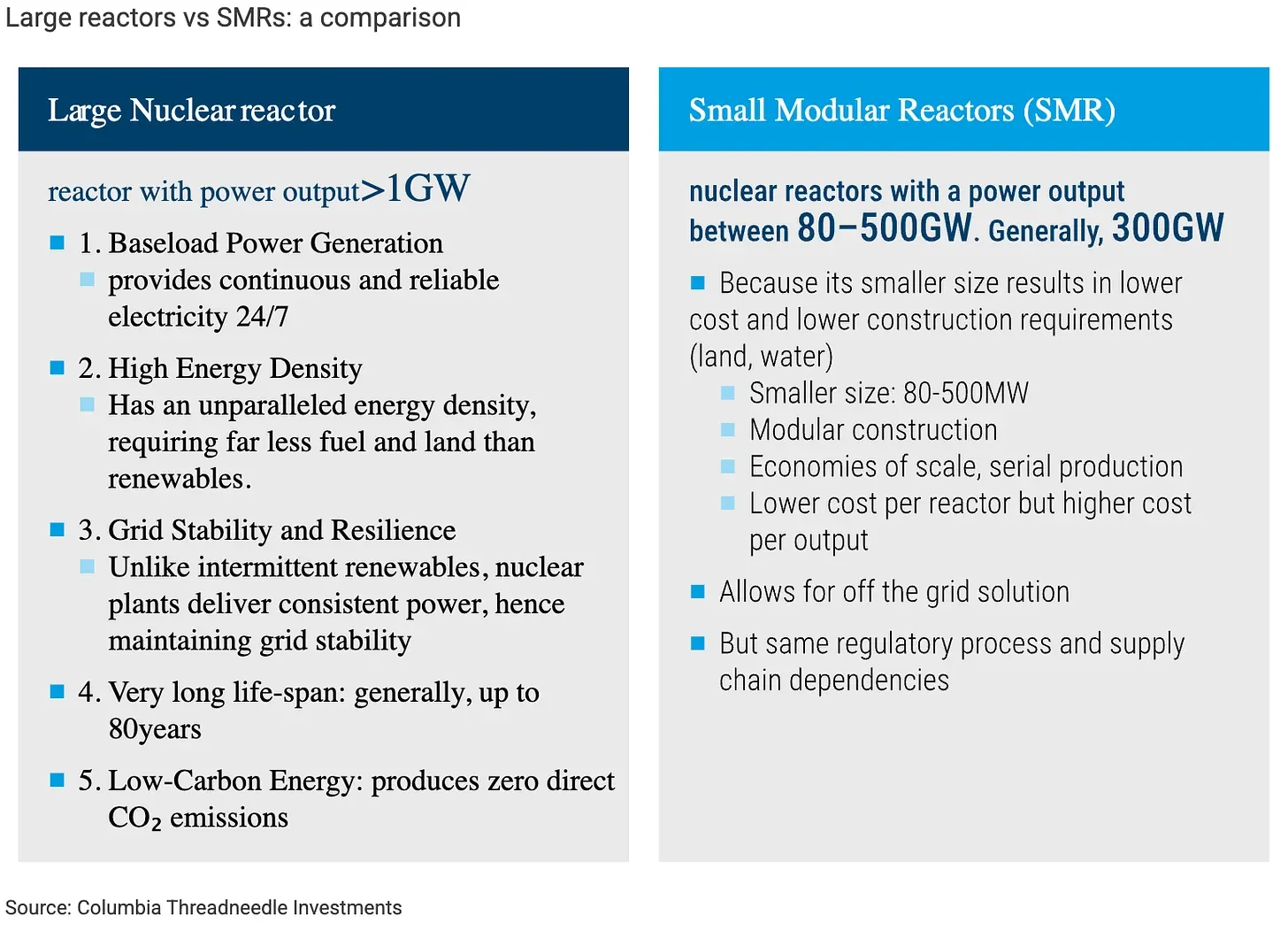
That brings us to nuclear fission and small modular reactors (SMR). For clarity, SMRs are a type of nuclear fission reactor. They have been making their rounds, and over the past five years, private-sector funding for fusion energy has peaked to the tune of $10 billion from a combination of venture capital, wealthy tech investors, energy companies, and governments.
But to be specific, when we say “nuclear” energy, there are two types:
Fission: currently used in active nuclear plants
Fusion: the theoretical stuff we haven’t quite implemented yet. It has been demonstrated in labs but has not yet been implemented as a commercial power source.
Nuclear fusion happens when two light atoms–usually forms of hydrogen–are heated until they become plasma. Under extreme heat and pressure, their nuclei collide and fuse, releasing huge amounts of energy. The main challenge here is making the reaction give off more energy than it takes to start and maintain it. To do this, scientists use two main methods: Magnetic confinement (which uses powerful magnets to hold the hot plasma in place without touching the reactor walls) and inertial confinement (which uses lasers to compress the fuel to very high densities). The heat from the fusion reaction can then be captured (like in coal plants) and turned into electricity.
Depending on the type of nuclear energy being discussed, different reactor designs are used. For nuclear fission, these include Light-Water Reactors (such as Pressurized and Boiling Water Reactors), Heavy-Water Reactors, Gas-Cooled Reactors, Molten Salt Reactors, Fast Reactors, and Small Modular Reactors. For nuclear fusion, reactor concepts include tokamaks, stellarators, and inertial confinement systems. What matters here is that each technology has fundamentally different engineering requirements, fuel cycles, and deployment pathways, which effectively determine where and how they can realistically be used in the energy system of these data centers.
It’s all very complicated, and people commit years of learning and practicing in order to master it, but the bottom line is that fission and fusion use completely different reactor types. So you can’t use the same reactor designs for both since the physics and engineering requirements are entirely different. But there is a clear connection between hyperscale data centers and nuclear power, so it’s worth understanding before connecting the dots.
How Data Centers Fit into The Puzzle
So, where are all of these data centers? Because there is no federal disclosure regulation for data centers, it’s hard to estimate, but here’s what has been legitimately collected by the Pew Research Center:
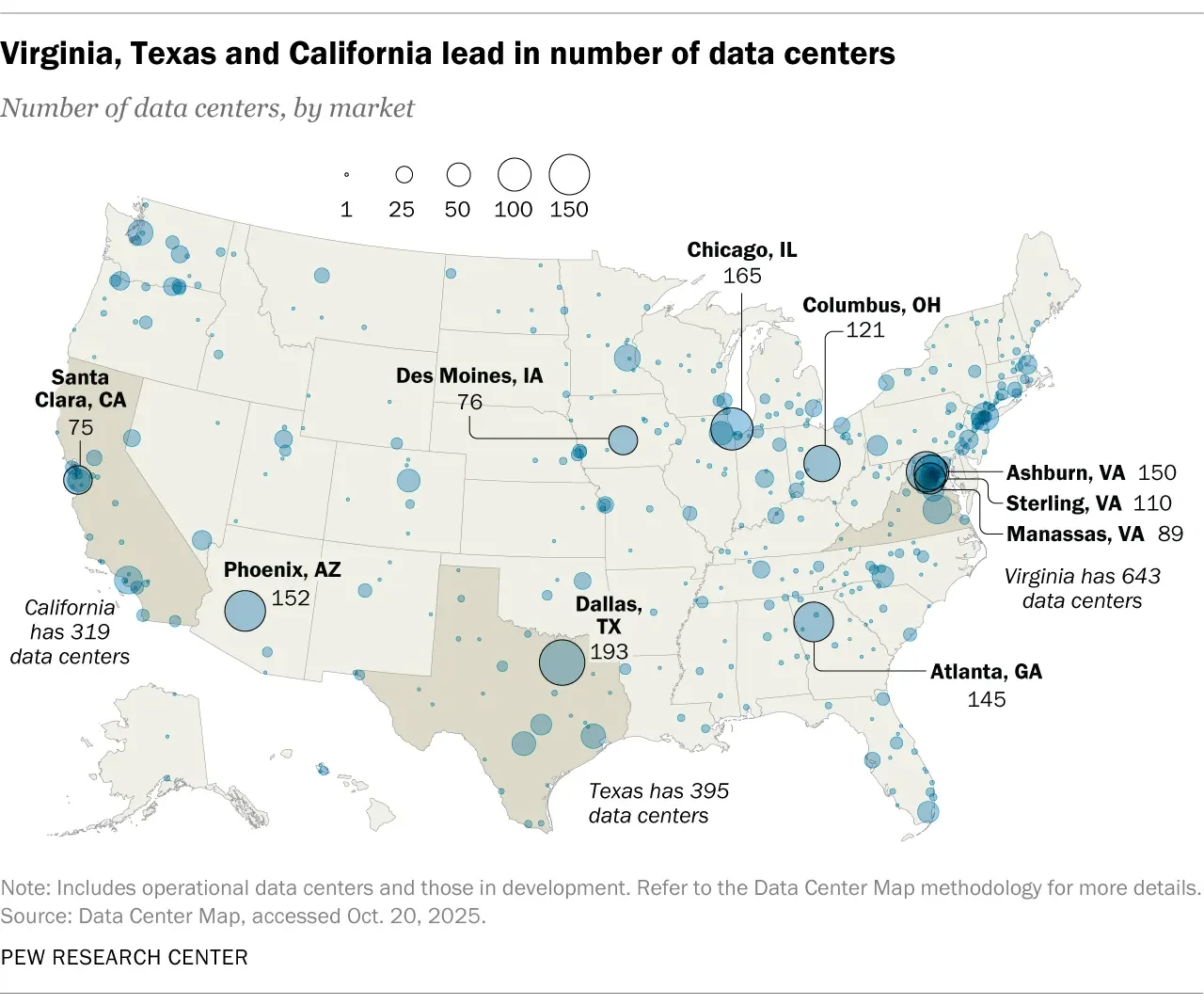
Why do these states see more data centers? Because of a number of factors, including but not limited to high-quality network access, ideal and cheap land partitioning, strong power infrastructure, and big tax incentives.
Additionally, the federal government has supported the proliferation of data centers in the U.S, dedicated to “AI inference, training, simulation, or synthetic data generation.” However, winning the AI race isn’t the only advantage of working for tech companies. The U.S. Department of Energy made a $1.5-billion conditional loan commitment to the Palisades Nuclear Plant, an 805-megawatt facility in Michigan. This is indicative of organizational realignment, which is extremely necessary for the development of this magnitude. It’s no longer just the tech companies; the government is also seeing this trend.
Just weeks ago, the Department of Energy announced the creation of the Office of Fusion and the Office of Artificial Intelligence and Quantum. Although this isn’t the first time the Trump administration has reorganized the agency, it speaks volumes about where attention is being directed in the DOE. Brian Smith, who worked previously with the DOE as a senior advisor in the nuclear energy sector but has since elevated to the INL as a director in the nuclear reactor development department, spoke to the revival of nuclear energy, especially after a relatively flat period between 2005 and 2017. It is generally known that a project this big needs entire countries to convene and institute. The U.S., France, and China are getting their boots on the ground.
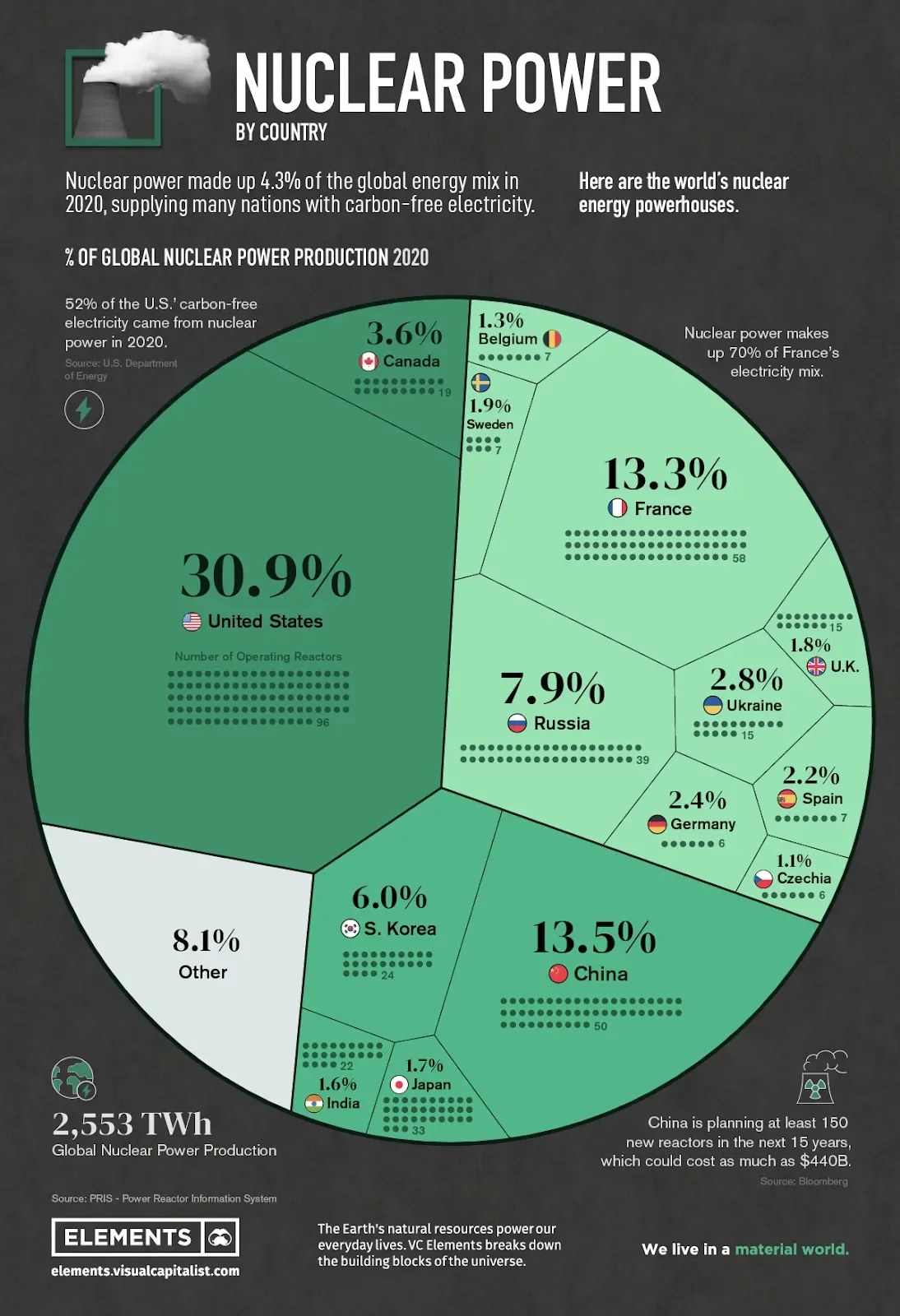
Visual Capitalist is a secondary aggregator and visualizer. While their charts are based on reputable sources, you should check the most recent data to see which countries produce nuclear power and how much. This data is from 2022, but nuclear reactors don’t go online every day, so this is more or less still where these countries stand.
Visual Capitalist is a secondary aggregator and visualizer. While their charts are based on reputable sources, you should check the most recent data to see which countries produce nuclear power and how much. This data is from 2022, but nuclear reactors don’t go online every day, so this is more or less still where these countries stand.
The role that governments play in propagating data centers or energy infrastructure is considerable, but there is still public debate on the extent of their involvement and specifically their limited capacity to go the extra mile. One of the only things that makes nuclear seem unapproachable at first glance is the initial cost. It takes years, not to mention millions of dollars, to get these plants online. Though capital costs are greater than those for coal-fired plants and much greater than those for gas-fired plants, they are cost-competitive with other forms of electricity generation. Nuclear becomes cost-competitive in countries with limited fossil fuel resources (e.g., Japan, South Korea, France). In the U.S., it’s especially worth noting that nuclear is all-in-all a bipartisan topic, so polarization isn’t slowing us down.
Another important note in any discussion about nuclear energy is described by Alison Hahn as “regulatory risks,” which “up until recently was huge for the nuclear industry.” After submitting an application to work in a reactor and getting the corresponding certifications, one can expect a years-long wait. But there is attention on the subject in the form of “wholesale rulemaking” in order to make this timeline more efficient for time-sensitive projects like those regarding data centers or oil and gas.
On the note of countries collaborating for the development of this nature, the public program most likely to demonstrate advancement in fusion is the ITER project. It is formerly known as the International Thermonuclear Experimental Reactor, and it’s a collaborative project of more than 35 nations that aims to advocate for the feasibility of nuclear fusion (the experimental one) as a sustainable energy source.
Solving a Problem
Amid the innovation lies a certain static factor that must be addressed: the people. As a result of increased energy consumption in states where these data centers are being built out/used, people’s energy bills are going up. And if there’s one thing Americans collectively dislike, it’s higher prices.
Nuclear fusion could tackle the energy affordability associated with hyperscale data centers. Nuclear fusion, with its potential for lower fuel costs and higher efficiency, could significantly reduce the long-term energy expenses that drive up datacenter operating costs. The economies of scale allow nuclear plant operators to spread costs over more generation, which results in a lower total generating cost. In 2023, the average total generating cost at multiple-unit plants was $29.53 per MWh compared to $41.62 per MWh for single-unit plants. Nuclear’s near-limitless clean power could stabilize or lower electricity costs, easing the burden on households as demand drives rates up. The Rockefeller Foundation estimates that “by 2050 nuclear energy represents 10 – 30% of generation in cost-optimal pathways, lowering total system costs by 2 – 31%”.
Building and maintaining fusion-powered data centers would also create high-skill, long-term jobs in engineering, operations, local infrastructure, etc.
But even beyond the price of energy, health (of communities and the environment) is a factor to consider. Fortunately, fusion’s advantage lies in its status as a “clean” energy source. Since fusion produces no air pollution or carbon emissions, it has a better wrap than, say, a coal plant.
However, beyond the health aspect of it, there is an economic hand at play. Coal plant closures have influenced the siting of new nuclear plants. On a very high level, it prompts a logical sequence of events: a coal plant in a small town goes offline; people lose jobs; the economy of said town struggles due to various economic and social factors; the prospect of reviving the economy presents itself in the form of a nuclear plant; people are trained to adapt; existing infrastructure is expanded upon.
What Activity is There Among Startups?
Facilitating fusion for energy production is a tall order. Nature achieves fusion reactions in the cores of stars, at extremely high density and temperature. Still, there are a number of startups working in each of these areas of nuclear energy.
Again, the problem to be addressed is energy consumption. We are looking at 12% of U.S. electricity use–half of which is for the actual IT equipment and the other half for cooling said IT equipment. If coal and fission plants stopped working today, nuclear fusion couldn’t fill their shoes, but that doesn’t mean it isn’t making progress. This electricity is used to power the AI and its related software that people consider the next “big thing”. Because of its nature being occupied by giants like Meta (whose slogan was literally “move fast and break things”), it’s not going to slow down for fusion. Nonetheless, there is a solution: fusion R&D and fission deployment can work in parallel with the AI race.
On the financial side, there’s no shortage of money. While there have been questions about how saturated the tech/AI space is with artificial investments, the money is clearly looking for somewhere to go. This is an epoch of technological innovation, and the emergence of nuclear energy is roughly aligned (emphasis on roughly). In general, the financial aspect is working in nuclear’s favor. Notable financiers, like Microsoft, are throwing their hats in the ring.
A few of the biggest names in the startup game in terms of funding and publicity are Valor Atomics and Helion Energy (which just started construction on a nuclear fusion plant to power Microsoft data centers). Valor Atomics is developing compact fusion reactors using a unique approach to achieve commercial fusion energy with smaller, more deployable systems. Helion Energy is using pulsed fusion with a field-reversed configuration to directly generate electricity (no steam turbines) via magnetic induction. This essentially means they are maximizing the efficiency of direct energy conversion.
Speaking of activity among startups, I find it prudent that the current incumbents in the “AI race” perform some sort of role in the advancement of nuclear energy. I am pleased to report that they are. Meta signed a 20-year agreement with Constellation Energy Corp. in June to procure 1,121 MW of “emissions-free nuclear energy” from the Clinton Power Station nuclear plant. In 2024, AWS invested $650 million for a 1,200-acre site next to the Susquehanna Nuclear facility for datacenter development. Microsoft signed a contract to restart Constellation Energy’s facility at the Crane Clean Energy Center Project (Three Mile Island), a $1.6 billion project. Google’s partnership with Kairos Power LLC aims for initial deployment in 2030 with a total of 500 MW by 2035. Amazon has also made a $500 million investment in the X-energy LLC reactor company, with plans to bring 5 GW of power online by 2039.
Obviously, the price tag on nuclear energy development calls into question how willing these companies are to overcome the initial cost. Once it does, there is compelling evidence that nuclear power can level up in competitiveness. The Levelized Cost of Energy (LCOE) of nuclear power in 2025 will range from about $55-$95 per MWh. This compares to a maximum of almost $100/MWh for coal and about $80/MWh for gas.” But as of now, the stigma around nuclear energy is that it’s more expensive and time-consuming compared to traditional and existing fossil fuel plants.
Moving forward isn’t easy, nor is it cheap. Sacrifices need to be made, and the prospect of having nuclear-run data centers poses many advantages to our collective goals: environmental sustainability, job growth, and decarbonization, to name but a few. The initial load growth is the barrier to entry for nuclear and needs to be addressed as such, but it’s an investment whose payoff unfolds over decades, not quarters.